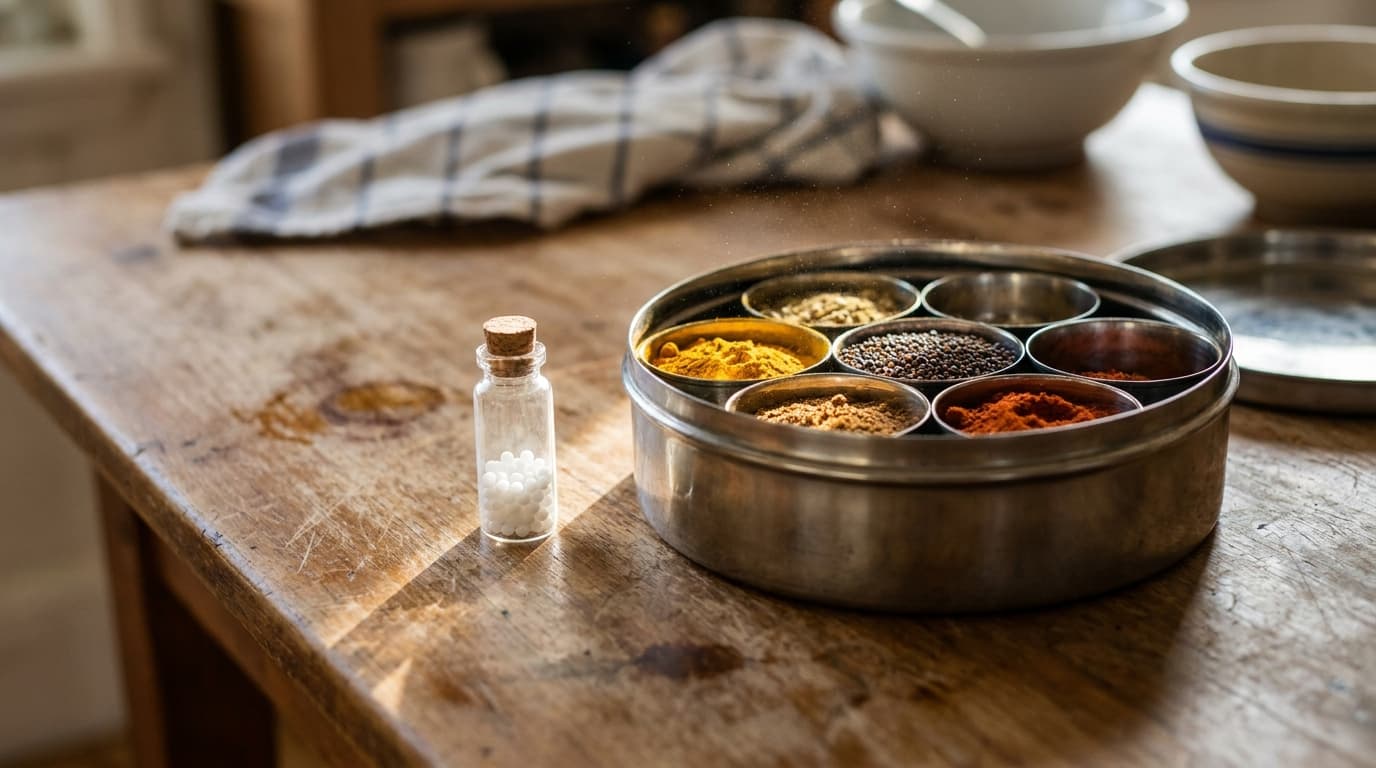
When I hand a patient a vial of white pills, their first reaction is rarely about the medicine itself. It is almost always a panicked question about food. "Doctor, do I have to stop eating raw onions? What about my morning coffee? My grandmother says I can't eat non-veg or brush my teeth with mint toothpaste while taking homeopathy."
The rules around eating and homeopathic medicine have grown into a massive knot of folklore, rigid traditions, and genuine misunderstandings. Patients often put themselves on incredibly restrictive diets, assuming that one wrong bite of food will completely destroy weeks of treatment. This causes unnecessary stress. Healing takes time, especially for chronic conditions you have carried around for years, and you do not need to make it harder by restricting foods unnecessarily.
The mouth is the gateway
The primary restriction in homeopathy is not about punishing your stomach. It is about protecting the medicine in your mouth. Homeopathic remedies do not act like standard chemical drugs that are broken down by your stomach acid and processed by your liver. They are absorbed directly through the fine nerve endings under your tongue and in the mucous membranes of your cheeks.
For this absorption to happen efficiently, your mouth needs to be a clean, neutral environment. If your tongue is coated with the heavy oils of a garlic pickle or the sharp sting of mouthwash, the nerve receptors are essentially blocked. The medicine cannot register properly.
The 30-minute rule
This biological fact is where the famous 30-minute rule comes from. You need to keep your mouth completely empty for half an hour before and half an hour after taking your dose. No food, no tea, no chewing gum, and no mouth fresheners. Plain water is fine. Once that thirty-minute window has passed, the medicine is in your system. You can then eat your breakfast or have your tea.
"What about toothpaste?" is usually the next question. Many patients are told to hunt down special non-mint toothpaste from the chemist. Unless your homeopath specifically tells you to avoid mint because it interferes with your exact prescription, standard toothpaste is fine. You just cannot brush your teeth five minutes before popping the pills. The strong flavour of peppermint oil overpowers those delicate nerve receptors. Wake up, brush your teeth, drink your water, and wait half an hour before taking your dose.
Borrowing rules from Ayurveda
A lot of dietary confusion happens because we borrow rules from other systems of medicine. Many patients come into the clinic trying to apply Ayurvedic principles to their homeopathic treatment. They ask if they should stop eating "heating" foods like papaya and sesame seeds, or if they need to avoid sour foods like curd and tamarind to prevent the medicine from spoiling.
Homeopathy does not classify foods as heating or cooling. If eating sour curd immediately worsens your chronic throat infection, you should absolutely stop eating it. But if you are taking medication for a completely unrelated issue, like hair fall or a fungal skin infection, a bowl of curd with your lunch will not stop the homeopathic medicine from working.
The truth about coffee
Let us talk about coffee. If you live in South India, asking you to give up your morning filter kaapi is a tall order. The widespread belief that coffee destroys all homeopathic treatment is simply outdated.
Coffee is a strong stimulant. It does antidote certain specific remedies. Nux Vomica, a remedy classically prescribed for severe acidity, irritability, and constipation in people who sit at desks all day and rely heavily on stimulants, is notoriously sensitive to coffee. If you are prescribed Nux Vomica, your doctor will likely ask you to stop drinking it entirely. But if you are taking a different remedy, like Rhus Tox for knee stiffness that gets worse during the damp monsoon months, your morning cup is highly unlikely to interfere with your progress. Just maintain the time gap.
Raw onions, garlic, and the daily tadka
The confusion over garlic and onions comes from their strong volatile oils. Raw onion leaves a sharp, lingering residue that alters the state of your oral mucous membranes for a long time. Cooked onion and garlic do not. The high heat of a tadka changes their chemical structure completely.
You can eat your regular dal fry. You can eat vegetable curries prepared with garlic paste. They are harmless to the medicine. Just avoid chewing on a raw onion salad with your lunch if you have to take an afternoon dose shortly after.
The one strict rule: camphor
While we can be flexible with coffee and cooked onions, there is one strict exception that applies across the board. Camphor is a universal antidote in homeopathic practice. It will neutralise almost any constitutional remedy you are taking.
In an Indian home, camphor is everywhere. It is the main ingredient in the strong pain balms you rub on your forehead for a winter headache. It is in the eucalyptus oil blends you drop on your pillow for a blocked nose. It is burnt daily during puja. If you are under active homeopathic treatment, you must keep strong camphor products away from your skin and out of your nose. If you apply a thick layer of a strong pain balm right after taking your medicine, you are wasting the dose.
Eating for your constitution
A good homeopath does not hand out a generic list of banned foods. Instead, we look at how food interacts with your specific illness and your physical constitution.
A patient who needs the remedy Lycopodium often suffers from severe gas and bloating that consistently peaks between 4 PM and 8 PM. They usually crave hot sweets. For them, treatment involves managing those specific sugar cravings and heavy evening meals alongside the remedy.
Someone needing Pulsatilla usually feels physically sluggish and nauseous after eating heavy, ghee-laden meals, rich gravies, or deep-fried pakoras. The medicine may help stimulate their system to heal, but they still need to step away from the heavy fats for the remedy to do its best work.
Someone who responds well to Natrum Mur will often crave salty snacks and feel physically drained by the hot summer sun. They need to monitor their salt intake, not because salt "kills" the medicine, but because their body already struggles to process it properly.
Keeping it practical
You do not need to live on bland khichdi just because you are taking a homeopathic remedy. Unless your specific medical condition demands dietary changes—like avoiding purine-rich foods for high uric acid, or skipping heavily spiced curries to manage a peptic ulcer—your regular home-cooked diet of roti, rice, vegetables, and dal is perfectly fine. The goal of constitutional treatment is to bring your body back to a state of balance where it can tolerate normal, everyday food without triggering a massive physical reaction.
Getting this right requires individual attention rather than reading generic lists on the internet. If you are struggling with a chronic issue, booking a video teleconsultation through Hello Homeo lets you speak directly with a doctor who can build a personalised treatment plan for you. They will review your symptoms, prescribe the right remedy, and tell you exactly which dietary habits are actually hindering your specific case and which ones you can safely ignore.
Keep your mouth clean before your dose, stay away from the camphor balms, and eat a sensible, normal diet. Let the medicine do its job.