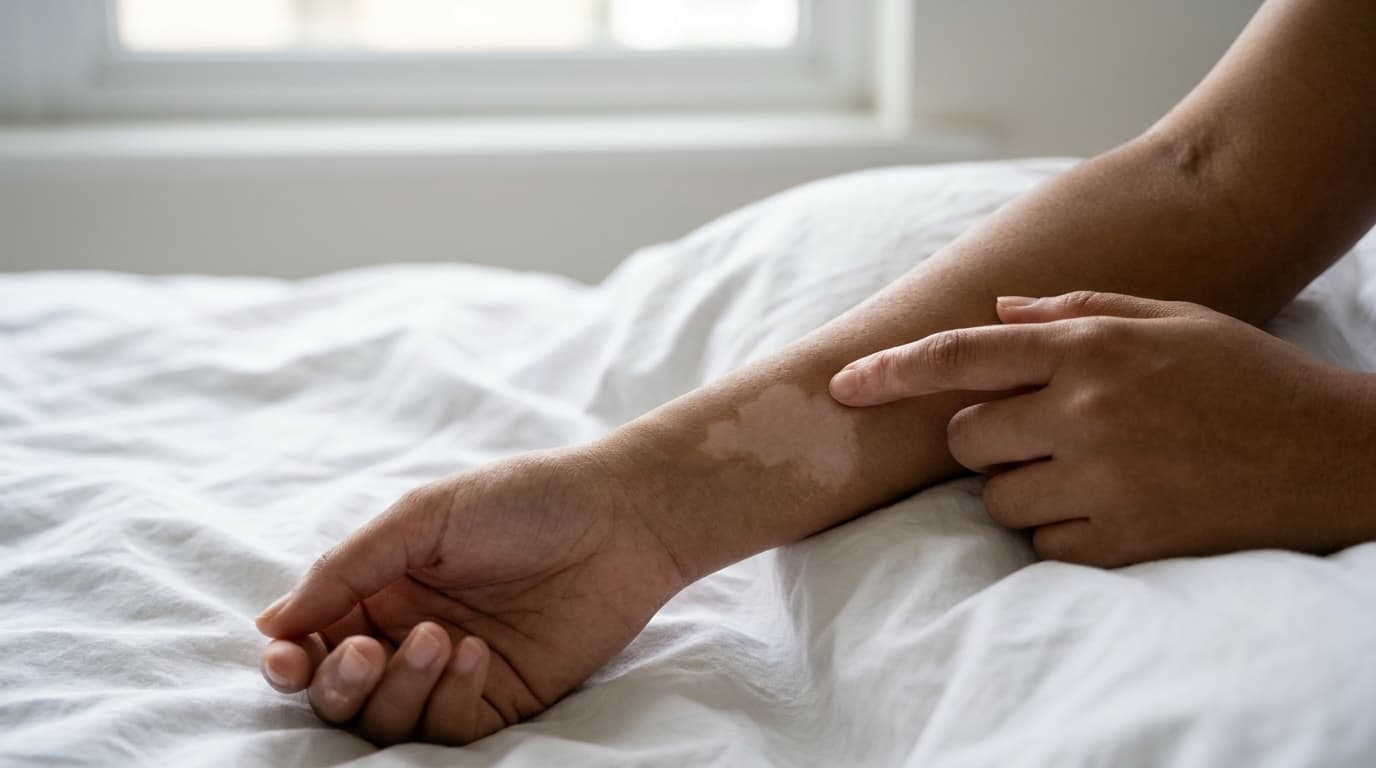
A woman in her thirties came to the clinic with a pale patch on her right wrist, roughly the size of a five-rupee coin. She had been applying babchi oil every night for four months and told me, flatly, that nothing had happened. It had. Under the lamp, along the lower edge of the patch, there were four small brown dots, each no bigger than a pinhead, sitting exactly where hair follicles were. That is repigmentation starting. She had been staring at the centre of the patch, where nothing changes for a very long time, and had decided the treatment had failed.
I've had that same conversation hundreds of times. Not because patients are careless, but because nobody told them where to look.
It's the immune system attacking melanocytes, not a skin infection
Vitiligo is autoimmune. The cells that make pigment, melanocytes, are being destroyed by the body's own cytotoxic T cells, and the white patch is simply what's left when they're gone. It affects roughly 0.5 to 1 per cent of Indians, and about half of all cases begin before the age of twenty. It is not contagious, it does not come from drinking milk with fish, and it has nothing to do with someone's blood being "impure".
What matters clinically is that vitiligo travels with other autoimmune conditions. Thyroid disease is the commonest, showing up in roughly 10 to 20 per cent of patients. B12 deficiency and diabetes are also more frequent than in the general population. So the first useful thing a good practitioner does isn't prescribing at all. It's finding out what else is going on.
The first job is stopping the spread, not making colour
Patients arrive wanting the white patch to fill in, and that is the wrong first target. An actively spreading case — new patches appearing every few weeks, older ones growing at the edges — will outrun any treatment. A homeopath will usually spend the first two to three months trying to settle that activity, watching whether the edges stay put. Only when the disease stops moving does repigmentation become a realistic conversation.
This is also when I ask about friction. Vitiligo follows injury to the skin in many people — the Koebner phenomenon — so a tight watch strap, a scratch from a branch, threading, or a sunburn on a Goa holiday can each produce a fresh patch at that exact spot. Until that pattern breaks, you're filling a bucket with a hole in it.
Where the colour comes back from
Two things happen when treatment works. The commoner one is perifollicular repigmentation: tiny brown dots appearing inside the patch, each centred on a hair follicle, which slowly enlarge and merge like islands joining up. The other is marginal repigmentation, where the patch visibly shrinks inwards from its border.
The middle of a large, long-standing patch may stay white for a year or more even while the edges are clearly recovering. Photograph the patch in daylight every two to three months, same time of day, same distance. The camera catches what the mirror can't, and it settles the argument about whether to continue.
Which patches respond, and which quietly don't
Location matters more than size. Patches on the face, neck, trunk and upper arms generally respond best, and eyelids often do surprisingly well with careful constitutional treatment. Fingertips, toes, palms, soles, lips and the genital area are stubborn — the follicle density there is low, and there's little for pigment cells to migrate from. A patch with white hair growing inside it (leucotrichia) carries a poor prognosis for repigmentation, because the follicle's pigment reservoir is gone too.
Segmental vitiligo — one-sided, following a nerve segment, usually starting in childhood — tends to stop spreading on its own after a year or two, but repigments poorly on any treatment. Patches older than five years are slower than recent ones. None of this means give up. It means be honest with yourself about which patch you're measuring progress by.
How a homeopath actually chooses a remedy
There is no homeopathic remedy "for vitiligo". Prescribing is constitutional — the remedy is chosen from the whole person, and the skin is one expression of that picture. Arsenicum album is classically indicated in the anxious, restless, chilly patient with dry scaly skin and burning or itching that worsens with cold. Natrum muriaticum suits the reserved person who holds grief privately, craves salt, and whose patches sit along the hairline or margins. Calcarea carbonica fits the fair, sweaty-headed, slow-metabolising patient who feels the cold badly.
Sepia is often considered where vitiligo follows pregnancy or years of exhaustion, with a flat, withdrawn mood. Nitricum acidum comes up in patients with a long history of repeated antibiotics and medication, splinter-like pains, and patches near body openings. Phosphorus for symmetrical patches in a sensitive, easily startled person worse from sun. Psorinum where the history is very long and itching is worse in the warmth of the bed.
I'll be straight with you about the evidence. Trials on homeopathy in vitiligo are few, small, and mostly uncontrolled. Some patients repigment substantially; many don't. Anyone who guarantees you full colour back is selling something.
Get these tests before you begin
- TSH with anti-TPO antibodies — an untreated thyroid problem will stall everything else
- Vitamin B12 and vitamin D
- Fasting glucose or HbA1c
- A complete blood count, and ANA if there are other autoimmune features
Correcting a B12 deficiency occasionally produces improvement that has nothing to do with the remedy, and it's worth knowing which one did the work.
How long this really takes
Three months is the first honest checkpoint, not three weeks. A visible difference usually takes six to twelve months of consistent treatment, and a large patch on the trunk can take eighteen months to two years. If the spread stops for a full year and the patches hold steady, that counts as a good outcome even if little colour has returned.
What defeats treatment more than the disease itself is switching remedies every month. Constitutional prescribing needs a fair run — usually eight to twelve weeks — before anyone judges it.
Things that genuinely slow it down
- Sunburn on a holiday, and harsh over-the-counter psoralen oils followed by direct sun, which burn skin and seed new patches
- Bleaching creams and "vitiligo cure" mixtures bought from a chemist's counter without a diagnosis
- Years of restrictive diets — no milk, no citrus, no fish — which have no evidence behind them and leave a child undernourished
- Chronic sleep loss and untreated anxiety, both of which patients notice worsen their patches
The social side needs saying too. School teasing and marriage negotiations do more damage to some patients than the condition does, and a practitioner who ignores that is only treating half the problem.
When to see a dermatologist alongside
Rapid spread — new patches appearing week after week — needs conventional stabilisation, and oral mini-pulse steroids or other immunosuppression are often used for that. Narrowband UVB three times a week, topical tacrolimus for facial patches, and melanocyte grafting for stable patches that haven't moved in a year are all legitimate options, and they can run alongside homeopathic treatment without conflict. Anyone with eyelid or genital involvement, or a child with segmental vitiligo, should be seen by a dermatologist at least once.
Hello Homeo is useful here mainly because vitiligo is judged over months, not visits — online consultations with a homeopathic doctor let you keep the same practitioner across a two-year course, and follow-up tracking with uploaded photos makes that pinhead-dot comparison far easier than trying to remember what the patch looked like last Diwali.
If you take one thing from this, take the photograph. Daylight, same spot, today and again in three months. That comparison, not the mirror on a bad morning, is what tells you whether the treatment is working.