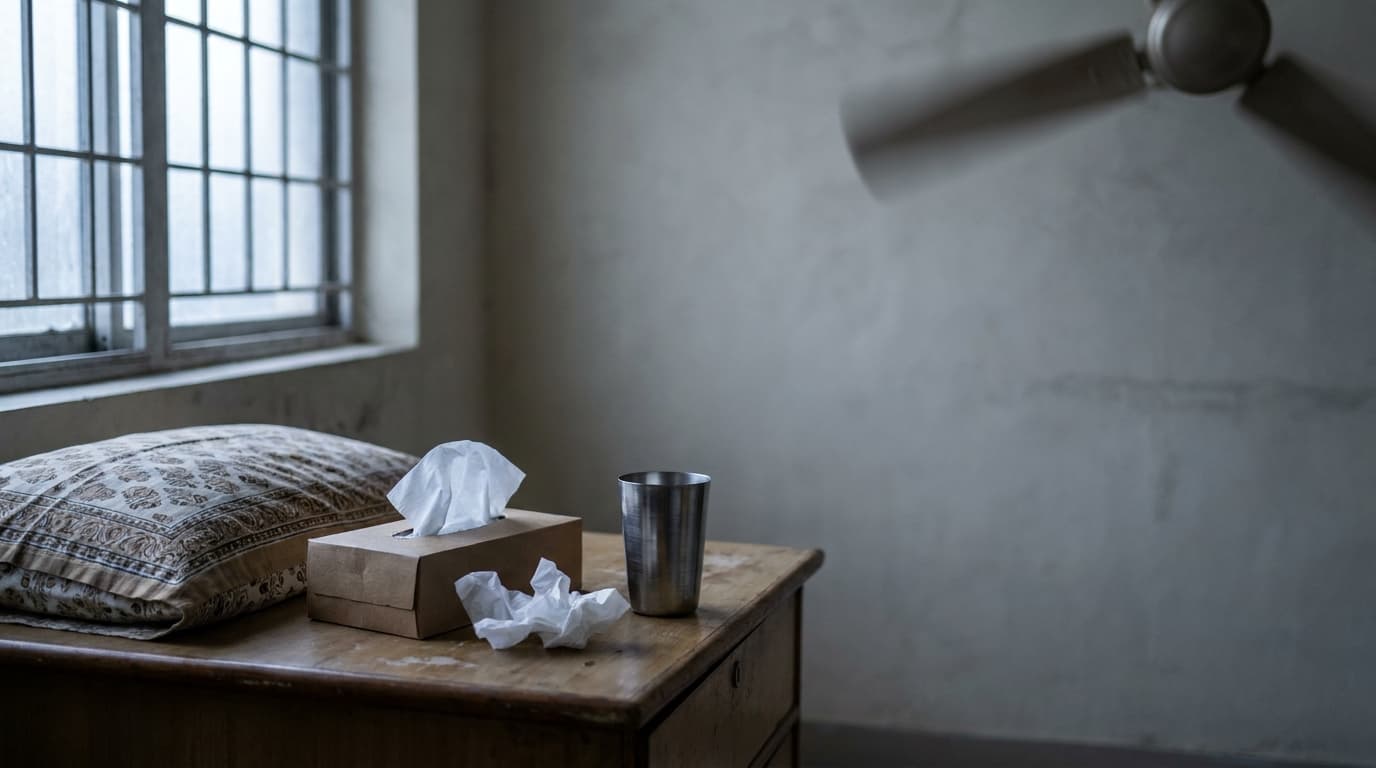
There's a patient I've seen hundreds of times over twenty years. He sits down and before I've asked a single question he says: "Doctor, it's not a cold. I sneeze exactly twelve times — I've counted — every morning at five, and then I'm fine till the next morning."
That count is the giveaway. A cold doesn't keep an appointment. Allergic rhinitis does, and it usually keeps it at the same hour, in the same room, or in the same three weeks of the year.
It isn't a cold that keeps coming back
Most people who come to me with rhinitis have already been treated for "recurrent colds" two or three times. Antibiotics were given, sometimes repeatedly, and nothing changed, because there was no infection to treat. The distinction is not difficult once you know what to look for. A viral cold comes with a sore throat, body ache, mild fever, and a discharge that starts watery and turns thick and yellow by day three before clearing in a week. Rhinitis brings itching — inside the nose, at the back of the palate, often in the eyes — a discharge that stays clear, and sneezing in bursts rather than one or two at a time.
Look at a child's nose and you'll often find a small horizontal crease across the bridge. That's from months of pushing the palm upward against a itchy nose, the "allergic salute". Dark smudges under the eyes, mouth breathing at night, snoring, a blocked ear after every episode — these are part of the same picture and they're worth mentioning to whoever is treating you, because they change the plan.
What is actually setting it off
In Indian cities, the biggest culprit by a wide margin is the house dust mite, and it lives precisely where you spend eight hours a night: the mattress, the pillow, the cotton mattress topper, the soft toys on the bed. It doesn't care about how clean your floors are. It cares about humidity and shed skin.
Then there's pollen, which is intensely local. Bengaluru's parthenium and the flowering trees along Old Madras Road cause a predictable February to April misery; Delhi's worst weeks are October and November, when dust and crop-burning smoke sit in the air and the morning sneezing starts before people have left the house. In the coastal cities, the trigger is often mould — the grey patches on the wall behind the wardrobe, the damp corner of the bedroom, the musty smell when the monsoon begins. Add to this cockroach residue in kitchen cabinets, pet dander, chalk dust in classrooms, and the very Indian triggers nobody mentions in textbooks: agarbatti and mosquito coil smoke in a closed bedroom, the ceiling fan blade that hasn't been wiped since last summer, and the naphthalene balls in the woollens that come out in November.
Some people have no true allergy at all. Their nose reacts to strong perfume, sudden cold, or smoke, and this is called vasomotor rhinitis. It matters, because the treatment approach is different and the response to avoiding allergens is nil.
Why a homeopath asks about your sweat and your grief
Here is the part that confuses people. Twenty patients with the same diagnosis will leave my clinic with maybe six different remedies, and the choice is not based on the nose alone. It's based on the whole person: what time the sneezing starts, what the discharge does to the skin above the lip, whether you feel better in a closed warm room or with a fan on, whether you're thirsty, how you sleep, how you handle anger and grief, what your childhood illnesses were.
Two people can both sneeze twenty times at dawn. One has a thin, burning discharge that reddens the upper lip and feels worse after midnight; the other has a bland, egg-white discharge and feels worse in the sun. Those are different remedies. This is the constitutional approach, and it's why the first prescription sometimes needs two or three revisions over a few months before it holds.
The remedies that come up again and again
Allium Cepa is the classic picture of streaming, acrid nasal discharge that burns the lip, with bland tears, better in open air and much worse on entering a warm room. Arsenicum Album suits thin, excoriating discharge with violent sneezing that starts after midnight, in a restless, chilly person who sips water frequently. Natrum Muriaticum is the remedy I think of for sneezing the moment the eyes open in the morning, with a discharge like raw egg white, worse in the sun, in someone who keeps their feelings closely guarded and craves salt. Nux Vomica fits the overworked, coffee-drinking, late-night professional who sneezes on waking and is irritable with it, better in the open air. Sabadilla has spasms of sneezing with intense itching at the back of the palate. Pulsatilla suits a thick, yellowish, bland discharge in someone weepy and thirstless who feels worse in a warm room. For the chronic case with crusts, recurring infections and poor resistance, Silicea is often considered; Kali Bichromicum where the discharge is ropy and the sinuses feel full; Euphrasia where the tears burn and the nasal discharge doesn't.
None of these should be picked from a list. The same symptom can point to three remedies and the deciding factor is usually something you wouldn't think to mention.
What homeopathy can and can't do here
The honest position: the trial evidence for homeopathy in allergic rhinitis is thin. A few small studies, most cited being Galphimia glauca in seasonal hay fever, suggest some benefit; most are poorly designed and none are large. Anyone telling you the case is proven is overselling it.
What I'd also say plainly is that homeopathy will not fix a deviated septum, a polyp, or a nose blocked by mechanical obstruction, and it won't replace an inhaler if there's wheeze. About two in five people with rhinitis have asthma or will develop it, and that needs conventional management alongside anything else you do.
Where it does help, in my experience, is in reducing the frequency and severity of episodes over a season or two, and in cutting down the dependence on a tablet every morning. That takes time. I tell patients to judge a constitutional remedy over three to six months, not three weeks, and to start treatment about two months before their bad season rather than in the middle of it. Children often improve as they grow, and some genuinely leave it behind by their teens. Adults usually improve rather than lose it.
One misconception worth clearing: taking an antihistamine during a bad week does not "spoil" the homeopathic treatment or suppress the disease. If you can't breathe at work, take the tablet.
The unglamorous things that work
Remedies do a good deal less when the bedroom is fighting back.
- Wash pillow covers and bedsheets weekly in hot water, and dry them in direct sun.
- Get zippered dust-mite covers for the mattress and pillow if you can afford them; if not, at least replace old cotton pillows.
- Remove carpets, and keep soft toys off the bed — or wash them and freeze them alternately.
- Wipe the fan blades and the top of the wardrobe before the season changes, not after.
- Keep windows shut between 6 and 9 in the morning during pollen season; that's when counts peak.
- Stop the agarbatti and the mosquito coil in the bedroom. Use a mesh screen instead.
Saline nasal rinsing is genuinely useful and costs almost nothing — half a teaspoon of salt in 250 ml of boiled, cooled water. Never use tap water straight from the tap; use boiled and cooled or distilled water, because the rare infections from unboiled neti water are serious.
When to stop and see an ENT
Some things need a camera up the nose, not a remedy. Book an ENT appointment if the blockage is consistently one-sided, if there's blood-stained discharge, if smell has disappeared and not returned, if there's facial pain or swelling, or if a child snores heavily, breathes through the mouth all night, and seems drowsy in school. Recurrent ear infections or hearing difficulty in a child with rhinitis also need examination rather than another prescription.
Follow-up is where this treatment is won or lost. Rhinitis is seasonal and slow, and the useful question in October is what happened last October and what the remedy did. Hello Homeo's video consultations suit this kind of case — a homeopath can take the long history that a constitutional prescription depends on without you travelling across the city — and its follow-up tracking means the notes from three seasons ago are actually there when the decision is made. Nothing replaces seeing a qualified homeopath in person for a proper case, but for the months of small adjustments in between, it's a workable arrangement.
If you're counting your sneezes every morning, that count is clinical information. Write it down, along with the time and the room, before your next consultation.