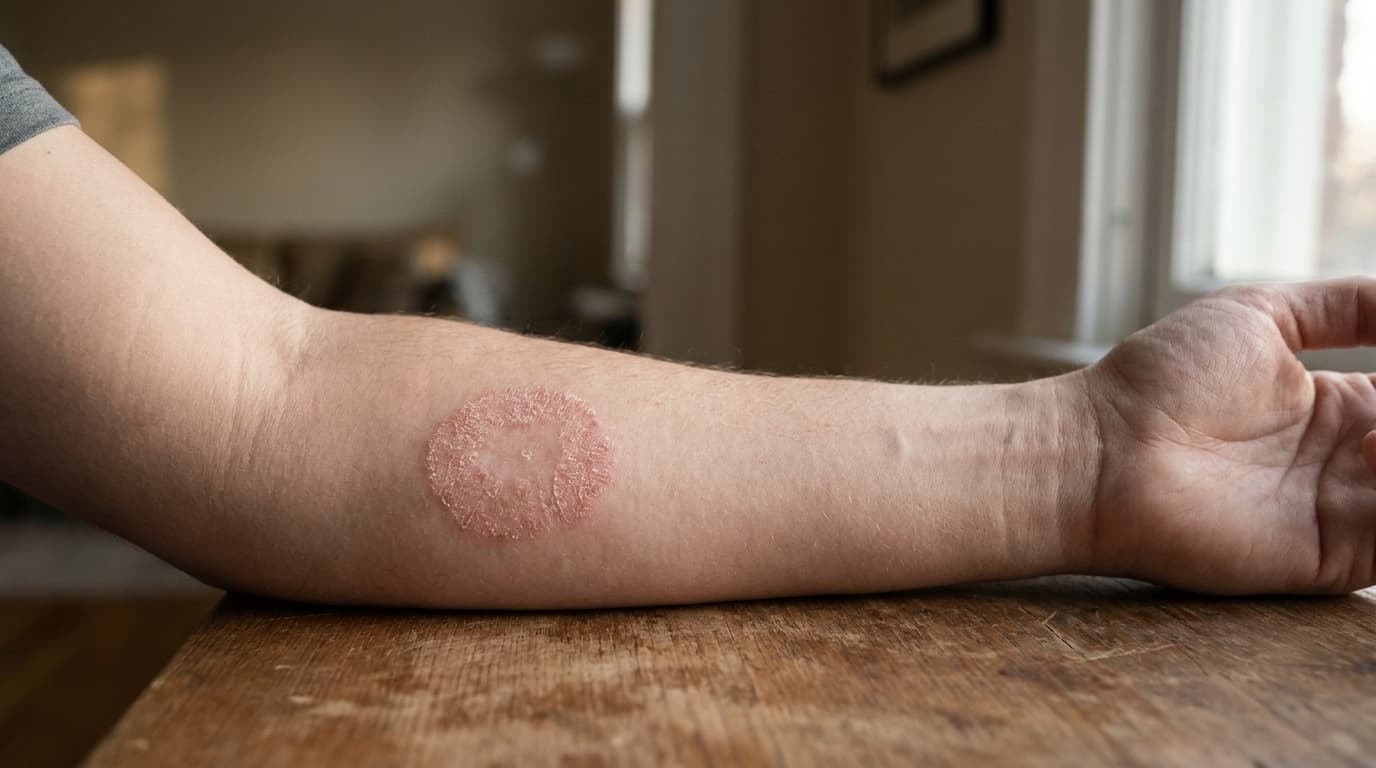
The cream is often the reason it's spreading
The ring on his forearm had started as one small circle. Eight weeks of a cream from the medical store and there were now five, spreading outward, the skin between them thin and shiny with fine red veins showing through. Dermatologists call this tinea incognito. The fungus didn't do it. The cream did.
Most of what gets handed over the counter for "ringworm" in India is a combination — clotrimazole or terbinafine mixed with clobetasol propionate or betamethasone, sometimes with neomycin added. The steroid flattens the itch and the redness within days, which feels like success. Underneath, it switches off the local immune response that was keeping the fungus contained, so the infection spreads quietly and returns angrier once the tube is finished. On the face it can leave a rash around the beard that looks nothing like a ring at all.
If you've been given one of these and the patch is growing or the skin is thinning, stop it — though not abruptly if you've used it for weeks. Show a doctor. Be sceptical, too, of any "homeopathic" antifungal cream sold loose without a proper label; several such products tested in India have been found to contain exactly the steroid they claim not to.
What these infections actually look like
Ringworm is a poor name. There's no worm. It's a group of moulds — dermatophytes — that digest keratin, the protein in skin, hair and nails, and they're happiest in warm, damp, occluded skin. That's why the Indian summer and the weeks before the monsoon are peak season, and why the inside of a sweaty vest or a tight school uniform is better real estate than an open forearm.
On the body it shows as a round or oval patch with a raised, scaly, slightly red border and a paler centre, itching enough to wake people at night. In the groin — tinea cruris, the jock itch that brings men in during May and June — the itch is worse after a long ride on a two-wheeler, worse in synthetic underwear, and often picked up from a shared towel at home. Between the toes it's peeling, white, sodden skin that cracks and stings; ask anyone who wears closed shoes for ten hours in Chennai. On the scalp it behaves differently and matters more: bald patches in children with broken hairs and black dots, which need oral antifungal medicine because nothing rubbed on the surface reaches the hair root.
Candida is a yeast rather than a mould. In babies it's white patches on the tongue and inner cheeks that don't wipe off cleanly, and a baby who pulls away while feeding. In women it's a thick white discharge with intense itching and burning, often in the week before a period, after a course of antibiotics, or when sugar control has slipped. Both deserve attention rather than tolerance.
Where homeopathy fits, and where it doesn't
I'll be straight with you: there is no good-quality trial evidence that homeopathic remedies cure dermatophyte infections. Anyone who says otherwise is selling something. What individualised homeopathy is traditionally used for is the itching, the broken sleep, the repeated relapses, and the constitutional picture of the person who keeps getting them — the one who sweats through his shirt by 11am, or whose skin splits open every winter, or who seems to catch everything going around. That's a modest claim, and it's the honest one.
What homeopathy is not is a replacement for oral antifungals in scalp ringworm, in nail infection, or in anyone with diabetes or a weakened immune system. Those need conventional treatment, and delay makes them harder to fix. Used alongside sensible hygiene and, where needed, conventional medicine, a constitutional course usually runs three to six months. That's longer than most people expect, and it's better said at the first consultation than the fifth.
Remedies that come up again and again
These are pictures, not prescriptions. The same ringworm on two people will often need two different remedies, and choosing between them is work for a qualified homeopath who has taken the whole case.
Tellurium is the remedy most often associated with ringworm of the body — circular, well-defined patches, maddening itch worse at night and worse from scratching, with skin that looks red and raw. Sepia suits moist ringworm in children and the chafed groin itch of someone worn down and wanting to be left alone. Sulphur is for the dry, scaly, violently itching eruption that's worse from the warmth of the bed, so the patient scratches until it burns. Graphites fits the cracks — behind the ears, in the folds under the breasts, between the toes — with a sticky honey-like oozing. Silicea is classically considered where foot sweat is offensive and the skin between the toes splits and refuses to heal, and it's also one of the remedies used for thickened, brittle nails. Psorinum is for the patient whose ringworm returns at the same time each year, with an offensive smell about the skin.
For vaginal candidiasis, Pulsatilla is traditionally indicated where the discharge is bland and creamy and the person is weepy, thirstless and worse in a warm room. Borax is the one for white patches in the mouth of a baby who cries while nursing, and Nitric acid where the discharge is scanty, sharp and excoriating. A homeopath may also suggest a Calendula wash for raw, weeping skin, though it does nothing to the fungus itself.
The unglamorous part that decides whether it comes back
No remedy, homeopathic or otherwise, outruns a wet towel. The fungus returns because the conditions that allowed it return.
- Dry properly, not quickly. Between the toes, under the breasts, in the groin — pat dry, then let the air get there for a few minutes before dressing.
- Cotton next to the skin. Synthetic vests, tight churidars and non-breathing shoes hold moisture against the body all day.
- Wash towels, vests and socks in hot water, and don't share them. Ringworm travels on cloth and on combs, which is how it moves through a whole family in a month.
- Treat everyone in the house who has it, at the same time. Reinfection from a child's scalp or a husband's groin is the commonest reason a well-treated patch comes back.
- Keep going after the itch stops. Skin looks normal weeks before it is clear, and stopping early is what produces the next round.
- If you have diabetes, check your sugar. Recurrent thrush and stubborn ringworm are sometimes the first visible sign that an HbA1c has crept up.
When to stop reading and see a doctor
Some of this needs conventional medical attention quickly. Scalp ringworm in a child, any nail involvement, infection spreading over a large area, or a patch that has been treated with a steroid cream and is now extensive — all of those need a dermatologist, and probably oral antifungal treatment. So does ringworm or thrush in anyone on chemotherapy, long-term steroids or immunosuppressants, and in anyone with poorly controlled diabetes.
Get seen the same day if there's fever with a spreading rash, if the skin is weeping pus or feels hot and tender, or if someone with low immunity develops sudden severe itching with a widespread rash. Thrush in an adult's mouth without an obvious cause — a recent antibiotic course, an inhaler — should be investigated rather than treated and forgotten.
For the everyday case, Hello Homeo offers video teleconsultation, which genuinely helps here because a ring on the arm or a peeling patch between the toes can be shown on camera rather than described down a phone line, along with follow-up tracking across the weeks it takes, since most people stop the moment the itching settles and then wonder why it's back by November.