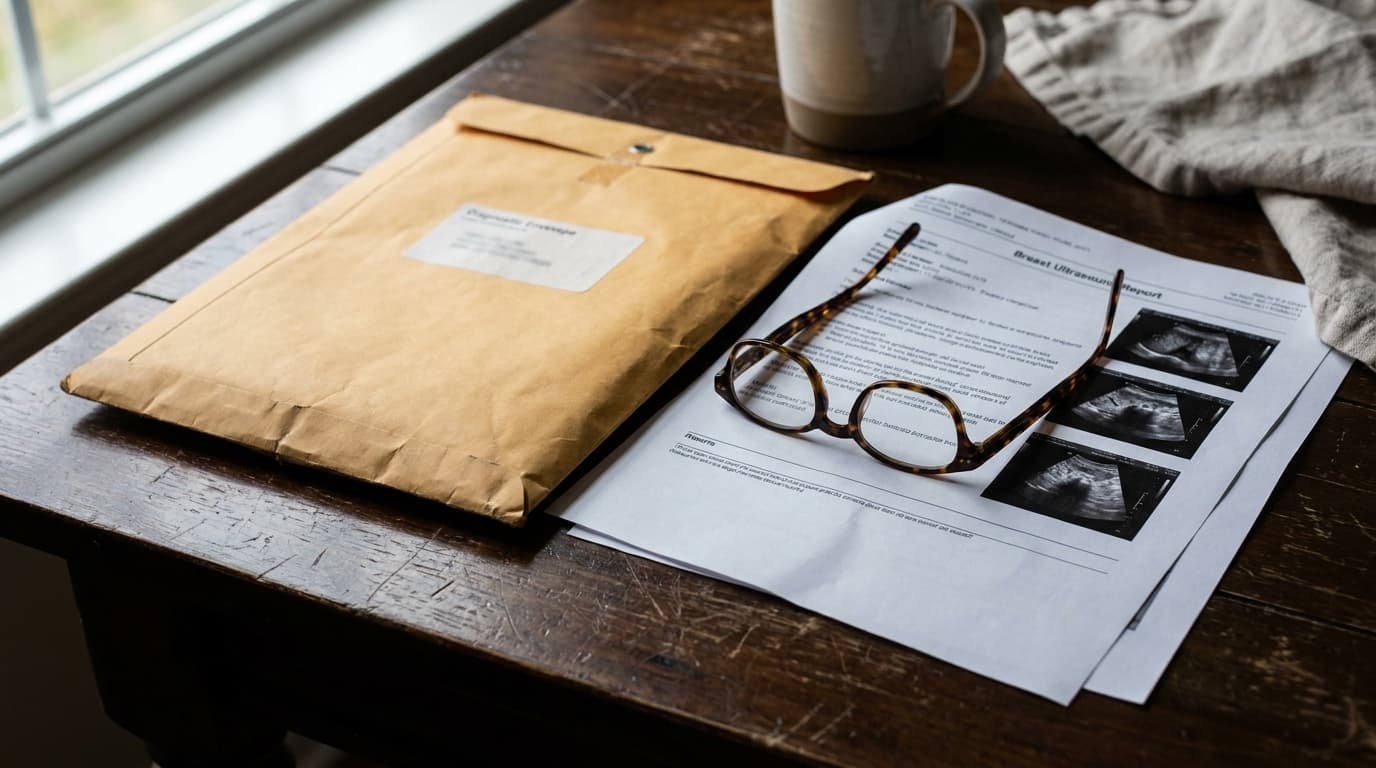
The moment of discovery
Finding a lump in your breast is a uniquely terrifying experience. A woman might be soaping in the shower or changing her clothes, her fingers brush against a hard knot that wasn't there last month, and her mind immediately jumps to the worst possible conclusion. In my clinic, I see women who have spent weeks losing sleep over this single discovery. Many hide the worry from their husbands or mothers because they fear the word 'cancer'.
Let us get the absolute, non-negotiable rule out of the way first. If you find a new lump in your breast, your next step is not a homeopath. It is a diagnostic centre.
You need a breast ultrasound or a mammogram, and quite often an FNAC (Fine Needle Aspiration Cytology). No responsible homeopath will prescribe medicine for a new, uninvestigated breast lump. We need black-and-white proof from a radiologist and a pathologist that the mass is a benign fibroadenoma or a simple cyst before we even begin to think about homeopathic treatment.
What exactly is a fibroadenoma?
When the scan report confirms a fibroadenoma, the immediate panic usually breaks. Fibroadenomas are harmless, non-cancerous overgrowths of glandular and connective tissue. If you press on them, they often feel rubbery, smooth, and slip away rapidly under your fingers. Older doctors used to call them a 'breast mouse' because of how they dart away from examination.
They are incredibly common among Indian women in their twenties and thirties. We often see them in unmarried daughters brought in by worried mothers. They are largely driven by fluctuating oestrogen levels, which is why they sometimes swell or become highly sensitive just before a menstrual period, and tend to shrink after menopause.
The limits of the surgical approach
The standard conventional advice for a small, painless fibroadenoma is simply to leave it alone and monitor it with yearly scans. If it grows large, becomes painful, or creates visible asymmetry, a breast surgeon will usually recommend excising it.
Surgery is highly effective at removing a specific lump. The frustration many women face, however, is that six months or a year later, a new lump appears in the same breast, or on the opposite side. Surgery removes the physical tissue, but it does not change the hormonal climate that allowed the fibroadenoma to grow in the first place.
This is exactly where constitutional homeopathy has a distinct purpose. We are not just trying to dissolve an isolated lump. We are trying to address the underlying physical tendency to form glandular overgrowths.
Matching the remedy to the patient
Homeopathic prescribing for breast lumps requires looking at the entire person. We ask about your menstrual history, your digestion, your thermal preferences, and your emotional state. A remedy is chosen because it matches this complete picture.
Calcarea Fluorica is frequently considered when the lump feels incredibly hard, almost stony. The tissue seems to have lost its natural elasticity, and the patient may also have a history of other connective tissue issues, like early varicose veins or joint stiffness.
Conium Maculatum is classically indicated when a lump develops after a blow or blunt injury to the breast. Women often dismiss a minor elbow knock in a crowded local train, or a toddler bumping hard into their chest. Weeks or months later, a painful nodule forms in that exact spot. The breasts typically feel extremely sore, heavy, and enlarged just before the menses begin, making it painful even to wear regular clothing.
When a patient describes breasts that are hard, swollen, and accompanied by pain that radiates sharply into the armpits or down the arms, a homeopath may look toward Phytolacca Decandra. This remedy is often associated with glandular swelling and a painful heaviness that worsens in damp weather.
Pulsatilla is frequently prescribed for young, mild-tempered women whose symptoms constantly shift. Their periods are rarely on time, the consistency of their menstrual flow changes from month to month, and the breast pain fluctuates wildly with their hormonal cycles.
Timelines and realistic expectations
Patients always sit across my desk and ask how fast the lump will vanish. I have to be entirely honest here. Homeopathy is slow when dealing with structural tissue changes.
You are looking at a minimum of three to six months of consistent treatment before we even order a follow-up ultrasound to check for progress. Sometimes the lump shrinks significantly. Very often, it simply stops growing, and the severe pre-menstrual pain disappears entirely, making the condition completely manageable.
Sometimes, if a fibroadenoma is old, heavily calcified, and very large, homeopathy will not reduce its size. In those specific cases, surgical removal remains the most sensible and pragmatic option. Homeopathy can then be used post-surgery to help prevent new lumps from forming.
Consulting a professional
Because treating a fibroadenoma safely requires matching a constitutional remedy to your exact physical and emotional makeup, you cannot self-medicate by buying bottles off a pharmacy counter. A platform like Hello Homeo allows you to securely upload your diagnostic ultrasound and FNAC reports, and consult with a homeopathic doctor via video teleconsultation from home. This ensures your medical history is fully understood before a personalised prescription is written.
Red flags you must not ignore
Even while undergoing homeopathic treatment for a diagnosed benign lump, you must remain vigilant. Your body changes, and you need to watch for signs that require immediate conventional medical attention. See a doctor urgently if you notice:
- A sudden, rapid increase in the size of the lump.
- The skin over your breast dimpling or puckering, looking like the skin of an orange.
- Your nipple suddenly turning inward (retraction).
- Any spontaneous discharge from the nipple, especially if it is bloody or clear and sticky.
- The lump becoming completely fixed to the skin or the chest wall, so it no longer moves under your fingers.
Benign breast lumps are a deep source of anxiety, but they are a manageable condition. Once a pathologist has ruled out malignancy, you have the safety and the time to treat the underlying hormonal tendency carefully.