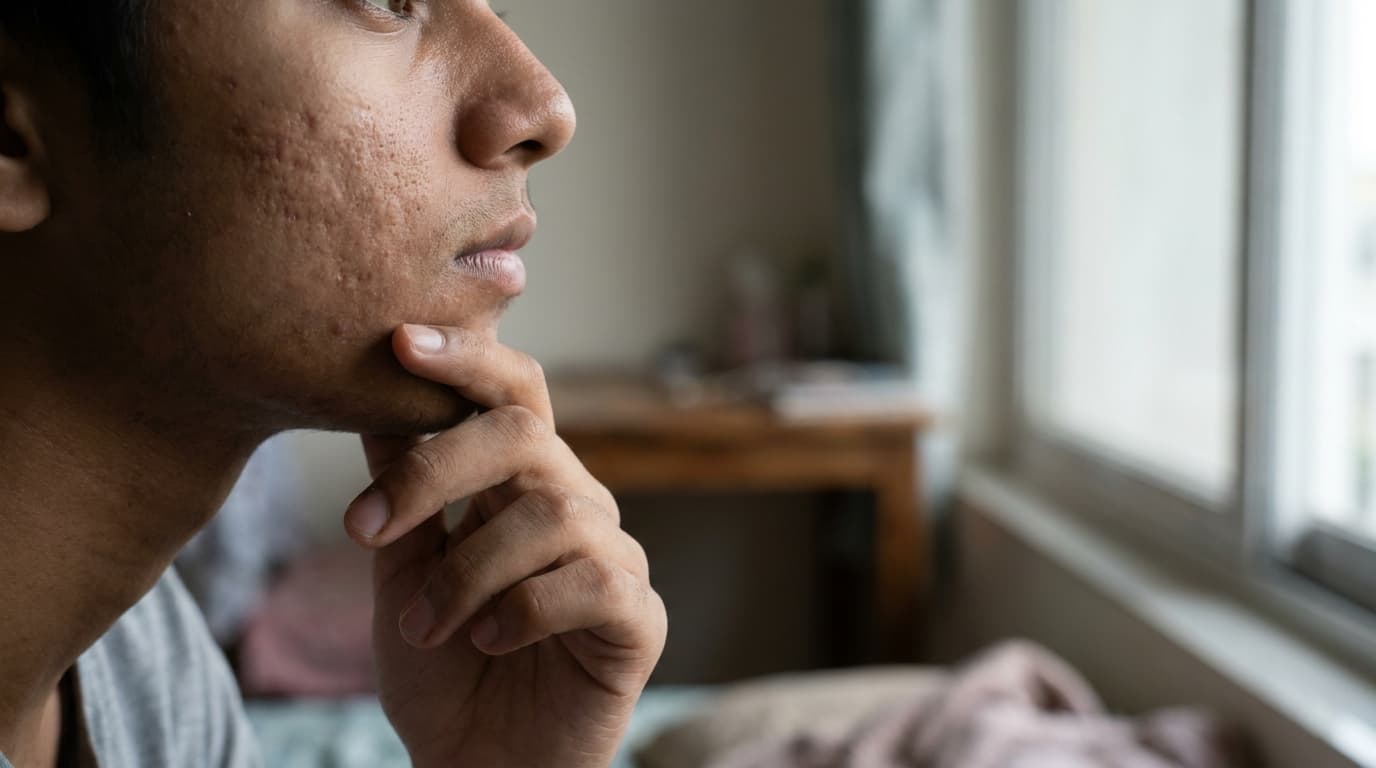
A woman in her late twenties turns her face to the window and says, "Doctor, these scars." She's had them nine years. What she's pointing at is flat. Brown. Slightly shiny where she's been rubbing oil into it every night. There's no dip, no ridge, no shadow when the light moves across it. It isn't a scar. It's a stain left by an old pimple, and it would have faded on its own years ago if she'd left it alone.
That confusion sits at the centre of almost every acne scar consultation I've had. Three different things get called "scar" — pigment, a dip in the skin, and a raised lump — and homeopathy has a genuinely different amount to offer for each. Getting the category right before buying anything is worth more than any remedy.
Flat brown marks aren't scars
Dermatologists call them post-inflammatory hyperpigmentation, or PIH. When a pimple inflames, the melanocytes underneath go into overdrive and lay down pigment. The skin surface stays smooth. Stretch it gently and look from the side: if the mark vanishes, it's pigment. If a pit or a ridge remains, that's structural.
Indian skin sits in the Fitzpatrick IV–V range, which marks easily. PIH is the most common thing I see in acne patients here, far more common than true scarring, and it is self-limiting. Left alone, most marks fade over three to twelve months. The catch is that new acne keeps laying down new pigment, so the face never looks like it's improving.
The three things people actually have
- Pigment — flat, brown or purplish, no change in texture, fades by itself with time and sun protection.
- Atrophic scars — ice-pick (narrow, deep), boxcar (square-sided), rolling (wavy). These are permanent changes in collagen, and the surface never returns to level on its own.
- Raised scars — hypertrophic scars and keloids, common on the jawline, chest, shoulders and back in Indian skin. They itch, sometimes grow for months, and run in families.
Where homeopathy is actually useful
The biggest win isn't the scar. It's the acne that keeps producing new ones. A constitutional remedy chosen on the whole picture — skin type, where the lesions appear, what makes them worse, sweat, menses, temperament, thermal preference — aims at reducing the frequency and depth of inflammation. Fewer deep nodules means fewer new craters. That's a real outcome, and it's slow.
For raised scars, homeopathy has a modest but real tradition. Keloids that are still active — itching, tender, growing — are sometimes treated with remedies that classically act on fibrous tissue, and I've seen softening over months in a few patients. I've also seen keloids sit unchanged through a year of treatment. Anyone promising you a flat jawline is overselling.
For atrophic scars, the answer is blunt: no remedy fills an ice-pick scar. Collagen that's gone doesn't come back because of a medicine. Those need a dermatologist — microneedling, subcision, TCA CROSS, fractional CO2 laser. Homeopathy can run alongside, particularly to calm the post-procedure pigmentation Indian skin is prone to, but it isn't a substitute.
The remedies a homeopath reaches for
Silicea is the one I think of first in a patient with thin, delicate, slow-healing skin, small pitted scars and a tendency to form keloids; typically chilly, with sweaty feet and a quiet, conscientious nature. Kali bromatum has a long-standing reputation for acne that leaves depressed scars, especially on the face, chest and shoulders, with hard indurated lesions. Sulphur suits red, itchy, burning skin that feels worse after washing, in a person who runs hot.
Where the lesions are pustular with yellow crusts and slow healing, Calcarea sulphurica is classically indicated; where they're deep, exquisitely painful and slow to discharge, Hepar sulphuris. Pulsatilla comes up often in young women with hormonal flares, weepiness and a dislike of warm rooms. Natrum muriaticum for acne along the hairline and chin, greasy skin, worse in sun, in someone who keeps their feelings to themselves. Graphites for skin that scars and cracks, with a sticky honey-like discharge. For old scar tissue itself, Thiosinaminum and Fluoric acid are the traditional choices, usually in low potency over months.
None of this can be picked off a page. Two patients with identical-looking scars will get different remedies, because the remedy is chosen on the person. A homeopath who prescribes Silicea to everyone with a pitted cheek is guessing.
The habits that decide the outcome
More than the remedy, what changes a face is what the hands do. Picking at a spot in the first three to five days, while it's still inflamed, is what converts pigment into a crater. The scar is made in that window, not later.
Sun protection isn't optional in India. Twenty minutes on a two-wheeler without cover darkens existing marks and slows their fading; a broad-spectrum SPF 30 or higher, reapplied, does more for PIH than most creams sold for it. And the fairness creams and steroid preparations bought quietly at the chemist — clobetasol, betamethasone, often in a "fairness" base — give two or three weeks of unusually smooth skin, then acne, thinning and visible capillaries. I see this in Delhi and Mumbai constantly. Stop it, and expect a flare before it settles.
Lemon juice, toothpaste, baking soda and salt scrubs all damage the barrier and deepen pigmentation. Besan or chickpea flour is fine for oily skin, but not over open spots. Wash twice a day with something mild, use a gel-based non-comedogenic moisturiser, and don't scrub.
How long, and when to see a doctor
Acne usually quiets by eight to twelve weeks of constitutional treatment. Real change in scarring tendency takes three to six months; keloids, six to twelve, with partial results at best. Expect photographs and dates, because memory is unreliable over that span.
Two situations need a conventional doctor promptly: nodulocystic acne that's leaving deep scars as it heals, and acne with sudden facial hair, irregular periods or weight gain, which points to PCOS. Both need assessment beyond homeopathy.
Hello Homeo is useful here mainly because acne treatment is judged over months, not weeks — an online consultation with a homeopathic doctor gets the full picture without a clinic visit, and follow-up tracking keeps the photographs and dates in one place so you can actually see whether the marks are fading. That's the part most people lose track of.