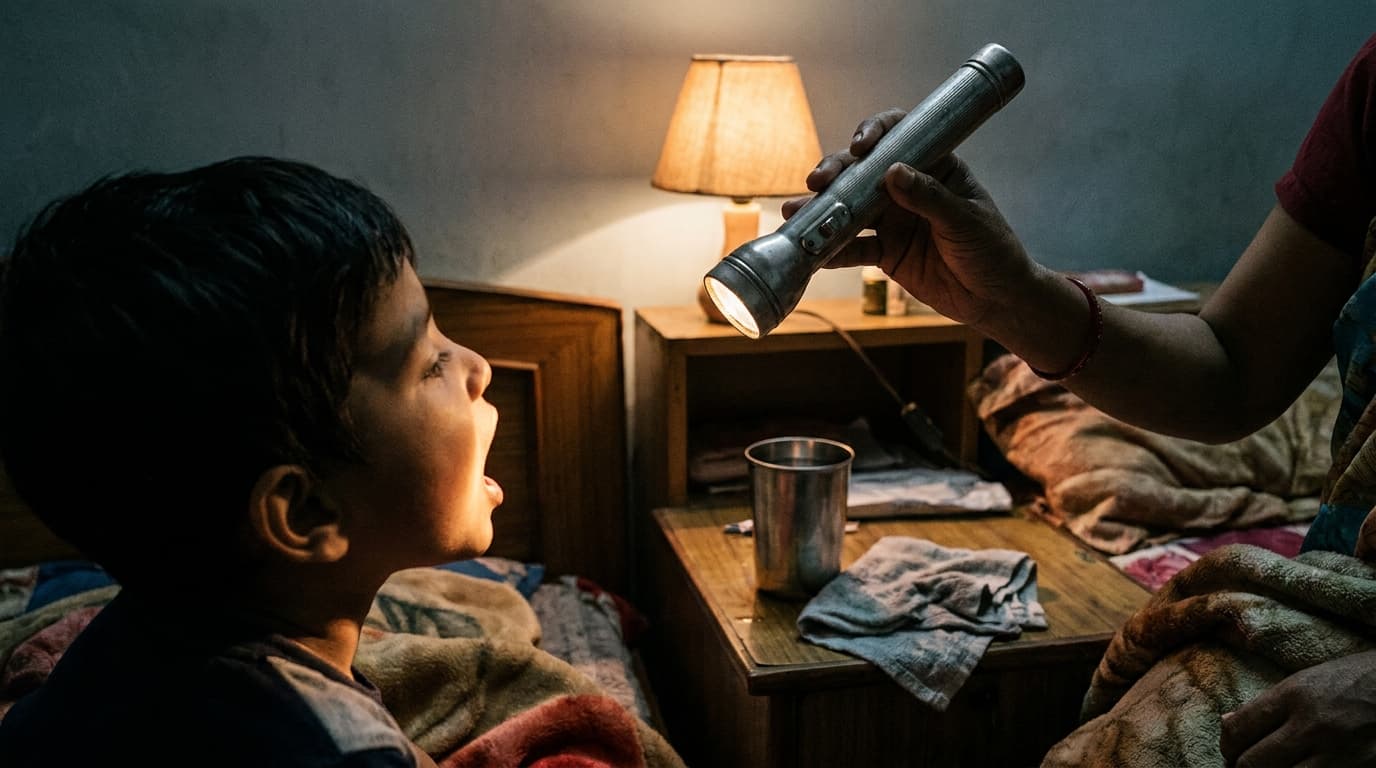
The 2am torch and the third antibiotic since April
You know the scene. It's past midnight, the child is hot to the touch and crying because swallowing hurts, and you're holding a small torch at an angle into a very small mouth, trying to see whether the tonsils have those white spots again. By Thursday there's a third antibiotic prescription since April, and in the clinic car park you start wondering whether these tonsils should simply come out.
That question is answerable, but not on the strength of one bad night. What decides it is a count.
Count the episodes before you decide anything
The single most useful thing I can tell a parent is this: in recurrent tonsillitis, the number and spacing of episodes decides almost everything — whether to treat, for how long, and whether a surgeon belongs in the conversation. Not how large the tonsils looked on the worst evening. Not how frightened you were.
So before the first consultation, start a note on your phone. Date. How high the fever actually went, measured, not guessed. Whether a doctor saw pus or sent a throat swab. Whether antibiotics were given and for how many days. Days of school missed. And one more column that parents almost never keep: whether the child snored that week, or breathed through the mouth at night. Six months of those entries is worth more than anything you can reconstruct from memory across a consulting table.
Meher's plan — a composite, not a real patient
What follows is not a case from anyone's file. It's a composite, assembled from a pattern I've seen hundreds of times, so you can see the shape a plan takes. It is not a prescription for your child. The remedy that fits one child's constitution is frequently wrong for the next one, even when the throats look identical.
Meher is seven, lives in Nashik, and has had six episodes in fourteen months. Two arrived in the monsoon, one in the winter, and three in a scattered fashion her mother can't tie to anything except a cousin's wedding and a school trip. She is thin, always cold, and her head sweats enough at night to damp the pillow. She drinks very little water, wants sweets, refuses milk. Her mother had her own tonsils removed at twelve. Between episodes her tonsils are enlarged but not touching in the midline, and she snores only when she has a cold. That last detail matters enormously later.
Track one: the first forty-eight hours of an episode
Acute prescribing here is about matching one of a small number of clear pictures, and it changes as the throat changes. Belladonna is classically indicated at the start — the child who was fine at four in the afternoon and burning by eight, face flushed, skin dry and hot, throat throbbing, worse at night, wanting to be left alone. Ferrum phosphoricum suits the slower, lower-grade beginning before anything looks dramatic. Hepar sulphuris comes in when pus appears and the child is desperately irritable, unable to bear cold air or the slightest touch at the neck. Mercurius solubilis fits the coated tongue, foul breath, drooling and mouth ulcers, all worse at night. Phytolacca when the pain shoots into the ears on swallowing and warm drinks help. Lachesis when it's the left side and anything tight at the throat is unbearable.
Potency and repetition are for the prescribing doctor to set. What I'd ask any parent to hold on to is this: if your paediatrician has prescribed a full course of antibiotics, finish it. Stopping antibiotics midway so a remedy can work undisturbed is not a sensible trade, and I've seen the consequences of it.
Track two: the work between episodes
The first constitutional consultation is long and mostly not about the throat. Sleep position. Where the child sweats. What she's like at a birthday party compared with at home. Food she craves and food she can't stand. Stools, teething history, vaccinations, and whether anyone in the family had tonsils or adenoids out. The homeopath is building a picture of the child, because the tendency to repeat these infections is what constitutional treatment is aiming at.
Remedies classically considered include Calcarea carbonica — the chilly, sweaty-headed child, often a little flabby, slow to walk, catching cold with every change of weather, tonsils persistently large. Baryta carbonica for the shy, slow-developing child with chronically enlarged tonsils and adenoids who seems to catch everything going. Silicea for the thin, chilly child with recurrent pus and slow-healing tendencies. Lycopodium where the right side is worse, symptoms build between four and eight in the evening, and the child is bossy at home and timid outside. Phosphorus for the friendly, anxious child whose tonsils bleed easily and who wants company. Occasionally a homeopath will weigh an intercurrent remedy such as Tuberculinum where there is a strong family history of tuberculosis and the child has not been well since one particular illness. That is a considered prescription, never something to buy and try.
What a year actually looks like
I won't dress this up. In the first three months, Meher will probably still get episodes. What usually changes first is their length and ferocity rather than their frequency — a throat that used to run five days settling in two, a fever that used to hit 103°F staying nearer 100°F. Between three and six months you start looking at spacing. The real test is the second monsoon and the winter after that, which is why most homeopaths want six to twelve months before judging anything, and why I'd be suspicious of anyone promising a fixed result in six weeks.
The evidence base is thin and I'd rather say so. There are a few small trials and reviews, generally of low quality, some suggesting fewer episodes and less antibiotic use in children given individualised homeopathic treatment. Nothing there justifies a promise. Homeopathy belongs alongside good paediatrics in this condition, not in place of it. And if twelve months of careful constitutional prescribing leaves the episodes just as frequent and just as severe, that is information rather than failure — it's a signal to review the plan and to see an ENT.
When surgery is still the right answer
The old counting thresholds still guide ENT practice: roughly seven episodes in one year, or five a year for two years, or three a year for three years, with documented fever, pus, positive swabs or enlarged neck nodes. But the criteria that would make me stop arguing for more time are different, and they're about obstruction rather than infection. Snoring most nights. Pauses in breathing that a parent has actually noticed. Constant mouth breathing, restless sleep, bedwetting that had stopped and restarted, daytime tiredness or a slide in school performance. That cluster points to sleep-disordered breathing, and no remedy plan should sit in front of the ENT appointment.
The same goes for a quinsy, for repeated abscesses, and for a child who is losing weight or missing weeks of school each term. Tonsillectomy is not a small thing — roughly a fortnight of significant pain, a bleeding risk of a few per cent, a general anaesthetic — but for the obstructive group in particular it genuinely helps. Refusing to discuss surgery is not the same as caring for the child.
Things that need a doctor today, not a remedy
- Drooling, unable to swallow saliva, a muffled voice, stiff neck, or a child who cannot open her mouth properly
- One tonsil hugely swollen with the uvula pushed to one side — possible quinsy
- No urine for eight hours or more, sunken eyes, no tears when crying
- Puffiness around the eyes, cola-coloured urine or passing very little urine in the two or three weeks after a sore throat
- Noisy or laboured breathing at rest
That fourth one catches families out. Post-streptococcal kidney inflammation turns up after the throat has settled, when everyone has relaxed, and it needs prompt medical attention.
Getting a plan started
For a child like Meher, the practical problem is that a feverish seven-year-old in a waiting room at 9pm is misery for everyone, and that the episode diary only becomes useful if someone actually reviews it across a year. Hello Homeo offers video teleconsultation with homeopathic doctors, which suits the acute days when travelling is the last thing you want, and follow-up tracking that keeps the record of episodes in one place instead of scattered across three paper prescriptions and your phone notes.
What none of that replaces is a proper individual consultation. Recurrent tonsillitis in a child needs the throat examined, the diary read, the sleep history taken seriously, and the remedy chosen for that particular child rather than for the diagnosis. If your son or daughter has had three or more episodes in the past twelve months, or snores most nights, book a consultation with a qualified homeopath and take the diary with you — and keep the ENT option open while you do.